
Basil Seeds vs. Chia Seeds: The Soluble Fiber Showdown for Satiety and Gut Motility
A clinical comparison of glucomannan fiber density, the 5-minute hydration speed advantage of Sabja seeds, and why basil seeds crush chia for ghrelin suppression and acid reflux relief.
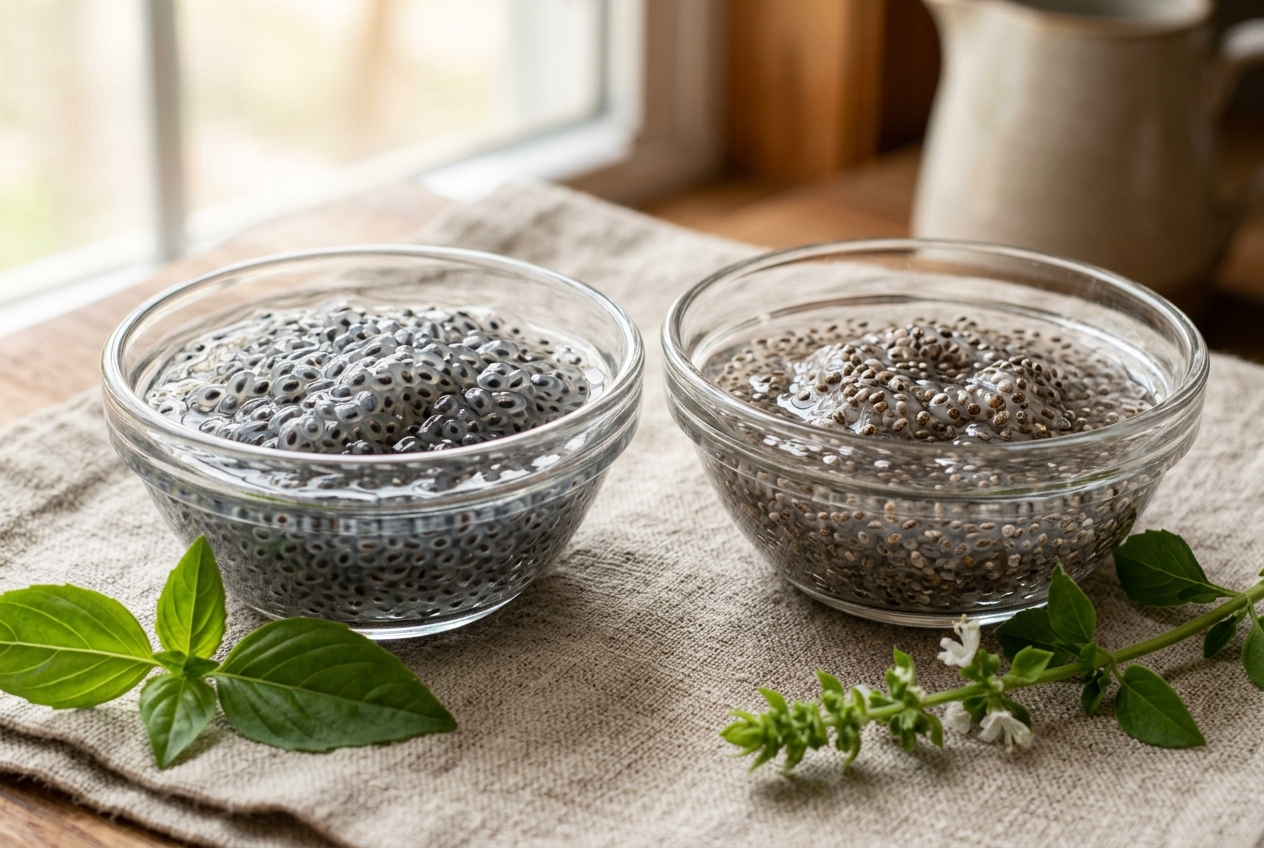
For over a decade, chia seeds (Salvia hispanica) have enjoyed an unchallenged monopoly as the Western world’s favorite hydrophilic superfood. Health enthusiasts rely on chia puddings and gels for breakfast meal prep, digestive regularity, and plant-based omega-3 fatty acids.
However, an ancient botanical contender from Ayurvedic and Persian medicine is rapidly disrupting the functional food landscape: sweet basil seeds (Ocimum basilicum), traditionally known as sabja or tukmaria.
While both seeds form a gelatinous mucilage envelope when submerged in liquid, their underlying biochemical kinetics, carbohydrate architecture, and therapeutic applications are remarkably distinct. If your priority is rapid hydration, aggressive satiety, gastric acid buffering, and maximum soluble fiber density, sweet basil seeds leave chia in the dust.
Basil seeds vs chia seeds: Basil seeds (sabja) hydrate significantly faster than chia seeds, expanding into a translucent hydrogel in just 5 minutes compared to 15 to 20 minutes for chia. While chia seeds dominate in anti-inflammatory ALA Omega-3s (5,050mg vs 1,000mg per 30g), sweet basil seeds contain 30% more prebiotic soluble fiber and provide potent Ayurvedic cooling (Sheeta Virya) for gastric acid reflux.
Above-the-Fold Functional Showdown Matrix
Review the side-by-side nutritional metrics, mucilage swelling speeds, and therapeutic mechanisms of a standard 30-gram (approx. 2 tablespoons) serving of both botanical seeds:
| Nutritional Metric (30g Dose) | Sweet Basil Seeds (Sabja) | Whole Black Chia Seeds | Showdown Winner | Physiological Outcome |
|---|---|---|---|---|
| Total Dietary Fiber | 14.8 g (50% by weight!) | 10.2 g (34% by weight) | Basil Seeds (+45%) | Colonic SCFA production & bulk transit |
| Hydration Speed (Room Temp) | 3 to 5 Minutes | 15 to 25 Minutes | Basil Seeds (5x Faster) | Instant prep without clumping |
| Alpha-Linolenic Acid (Omega-3) | 2.8 g | 5.1 g | Chia Seeds (+82%) | Cellular anti-inflammatory signaling |
| Total Net Carbohydrates | 0.4 g (Virtually Zero) | 1.8 g | Basil Seeds | Zero glycemic or insulin response |
| Complete Plant Protein | 4.2 g | 4.7 g | Chia Seeds (Slight Edge) | Amino acid replenishment |
| Mucilage Polysaccharide Type | Glucomannan & (1→4)-β-D-Xylan | Xylose, Glucose & Glucuronic Acid | Tied (Different mechanisms) | Viscous gastric distension vs. gel flow |
| Gastric Acid Buffering (GERD) | High (Alkalizing mucosal coat) | Moderate | Basil Seeds | Relief from heartburn and acid reflux |
1. Microscopic Hydration Kinetics: The 5-Minute Sabja Phenomenon
The most striking practical difference between these two botanicals is how they react when introduced to water:
[ Sweet Basil Seed (Sabja) in Water ] ──► Instant Swelling (30 sec) ──► 100% Saturated Gel (3-5 min)
[ Chia Seed in Water ]                ──► Slow Permeation (5 min)    ──► 100% Saturated Gel (20-30 min)
Why Basil Seeds Swell 5x Faster:
Under scanning electron microscopy, the pericarp (seed coat) of Ocimum basilicum reveals an open, porous, honeycomb-like cellular network. * The moment water contacts the seed, capillary action draws liquid deep into the mucilaginous cells within seconds. * The outer layer bursts outward, forming an opaque, pearlescent white gelatinous sphere encasing a tiny, jet-black central seed. * Within 180 to 300 seconds, basil seeds absorb approximately 10 to 12 times their weight in water.
In contrast, the seed coat of Salvia hispanica (chia) is covered in a tighter, denser wax-like cuticular layer. Water molecules must slowly penetrate this outer lipid membrane before the underlying polysaccharides can hydrate. As a result, chia seeds often clump together into stubborn dry pockets unless stirred vigorously and rested for at least 15 to 20 minutes.
2. Fiber Architecture & Ghrelin Suppression: The Glucomannan Advantage
While chia seeds are deservedly praised for their 10.2 grams of fiber per serving, sweet basil seeds deliver an astonishing 14.8 grams of dietary fiber per 30 grams—making them nearly 50% pure dietary fiber by dry weight.
🌱 Editor's Recommended Organic Seeds
Third-Party Lab Tested- 100% Certified USDA Organic Ocimum basilicum
- Raw, unpasteurized, and non-irradiated whole black seeds
- Swells to full gelatinous volume in under 5 minutes
- Over 14g of soluble prebiotic fiber per 2-tablespoon serving
- High-altitude grown for peak Alpha-Linolenic Acid (ALA)
- Triple-cleaned and certified non-GMO and gluten-free
- Delivers 5,100mg plant-based Omega-3 per 30g serving
- Ideal for slow-release overnight breakfast puddings
The Satiety Mechanism: Glucomannan and Gastric Distension
Crucially, the fiber fraction of basil seed mucilage is dominated by glucomannan (approx. 43%) and β-D-glucan complex polysaccharides.
Glucomannan forms a highly viscous pseudoplastic gel in the stomach that: 1. Triggers Mechanoreceptors: The expanding gel physically stretches the gastric mucosal walls, signaling vagal afferent nerve pathways to decrease the secretion of ghrelin (the “hunger hormone”). 2. Slows Alpha-Amylase Hydrolysis: The gel matrix traps co-ingested dietary carbohydrates, slowing down enzymatic starch breakdown and smoothing postprandial glucose curves. 3. Prebiotic Bifidogenic Fuel: In the cecum and ascending colon, the glucomannan and xylan residues are fermented by Bifidobacterium species into high quantities of acetate and butyrate.
3. Ayurvedic Cooling Energetics (Sheeta Virya) & Acid Reflux Relief
In traditional Indian Ayurvedic medicine, sweet basil seeds (Sabja) are classified under the energetic principle of Sheeta Virya (cold potency). They have been prescribed for centuries during scorching summer months to disperse metabolic internal heat (Pitta).
Modern physiology provides an elegant biological explanation for this traditional observation: * The Alkaline Mucosal Barrier: The thick, viscous mucilage released by basil seeds acts as a physical protective coating across the esophageal and gastric mucosa. * Gastric Acid Quenching: In individuals suffering from gastroesophageal reflux disease (GERD), drinking a glass of water containing 1 tablespoon of pre-hydrated sabja seeds provides immediate mechanical relief by buffering hydrochloric acid and protecting esophageal epithelial junctions from pepsin erosion.
4. How to Prepare and Consume Sweet Basil Seeds Daily
Unlike chia seeds, which are frequently baked into breads or crackers, sweet basil seeds are almost exclusively consumed fully hydrated:
The 5-Minute Sabja Hydration Protocol:
- Add 1 tablespoon (12g) of dry sweet basil seeds to a tall glass.
- Pour in 8 to 10 ounces (250ml) of cold or room-temperature liquid (filtered water, coconut water, lemonade, or iced herbal tea).
- Stir vigorously with a spoon for 30 seconds.
- Watch as the seeds instantly begin releasing their translucent jelly envelopes. By the 4-minute mark, the beverage is ready to drink.
Flavor Profile: Hydrated basil seeds have a crisp, poppy center surrounded by a silky gel coating. They are virtually tasteless and take on the flavor of whatever liquid they are steeped in, making them exceptionally versatile for drinks, chilled fruit soups, and yogurt bowls.
Integrating Basil and Chia Seeds into a Complete Botanical Regimen
Both sweet basil seeds and chia seeds provide unmatched prebiotic mucilage and gut-protective arabinogalactans. To ensure you hydrate chia seeds safely without esophageal swelling risks, read our clinical chia seeds hydration protocol. For a full comparative breakdown of chia against hemp and flax, review our hemp vs chia vs flax nutrient density guide.
You can easily log both sabja seeds and chia seeds in your weekly diversity goals using our 30-Plants Microbiome Diversity Tracker (see our full 30-plants protocol) and simulate their daily fiber yields with our Daily Seed Nutrition & Protein Stacker.
5. Summary: Building the Ultimate Daily Hydration Routine
Both basil seeds and chia seeds deserve a permanent place in an evidence-based botanical wellness protocol: * Use Sweet Basil Seeds (Sabja): In morning hydration drinks or before heavy meals to curb appetite, accelerate bowel motility, and protect against midday acid reflux. * Use Chia Seeds: In overnight puddings, baked nutrient loaves, or stacked with flaxseeds to deliver high-dose anti-inflammatory ALA Omega-3 fats.
To model the exact macronutrient and fiber yields of stacking basil seeds, chia seeds, and hemp hearts, explore our Daily Seed Nutrition & Protein Stacker, or log your intake of botanical species on our 30-Plants Microbiome Tracker.
Frequently Asked Questions: Basil Seeds vs Chia Seeds
Yes, significantly faster. Sweet basil seeds (sabja) achieve full hydration within 3 to 5 minutes of contact with water, expanding into a thick, translucent jelly sphere with a jet-black center. Whole chia seeds require at least 15 to 25 minutes of room-temperature soaking (or several hours in cold liquid) to achieve an equivalent state of mucilaginous expansion.
Basil seeds hold a distinct advantage for acute satiety. With nearly 15 grams of total dietary fiber per 30-gram serving (compared to 10 grams in chia), basil seed mucilage contains a high fraction of glucomannan, a polysaccharide that expands vigorously in the stomach, physically distends gastric stretch receptors, and delays ghrelin (hunger hormone) secretion.
Yes, sweet basil seeds (Ocimum basilicum) have been safely consumed for millennia in Persian, Ayurvedic, and Southeast Asian medicine (often in cooling beverages like Falooda). Because they hydrate so rapidly, always pre-soak them in ample water (at least 1:10 ratio) before drinking. Avoid consuming them completely dry to prevent swallowing discomfort.
While basil seeds dominate in dietary fiber (15g vs 10g per 30g) and hydration speed, chia seeds remain superior in essential fatty acids. Chia delivers over 5,000 mg of Alpha-Linolenic Acid (ALA Omega-3) per serving, whereas basil seeds contain substantially lower total lipid concentrations (roughly 4g of fat compared to chia's 9g).