
Black vs. White Sesame Seeds: The Calcium Absorption Trap & The 400% Tahini Bioavailability Rule
A clinical investigation into Sesamum indicum: comparing sesamin lignans, melanin-derived anthocyanins, calcium-oxalate chelation in raw hulls, and why stone-ground tahini quadruples mineral absorption.
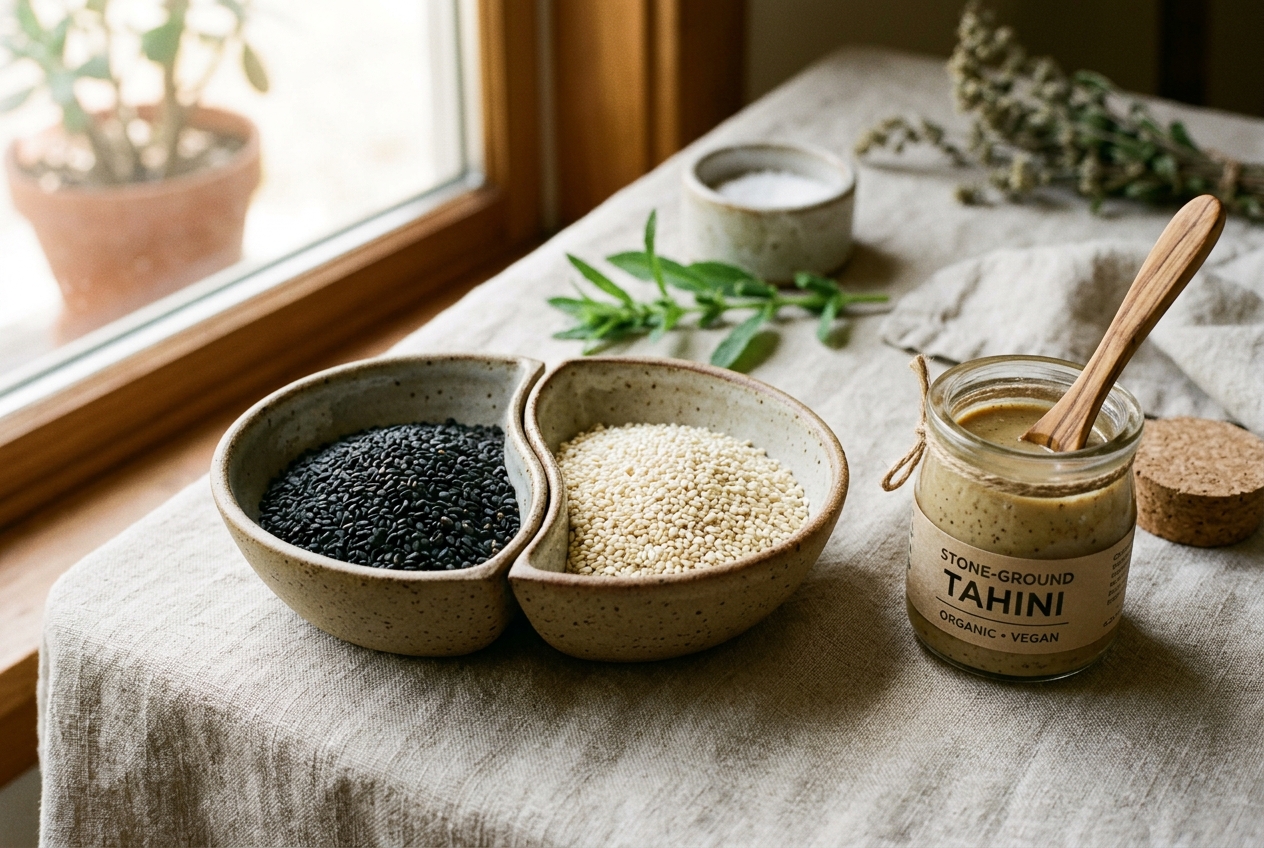
In the global hierarchy of oilseeds, sesame (Sesamum indicum) is one of the oldest cultivated crops known to civilization, prized across ancient Mesopotamia, Egypt, and India for over 5,000 years.
Black sesame seeds vs white: Black sesame seeds retain their intact, mineral-rich outer husk, delivering up to 10 times more calcium (approx. 975mg vs 60mg per 100g) and substantially higher concentrations of protective sesamin lignans and melanin antioxidants than hulled white seeds. However, to absorb these minerals, seeds must be stone-ground into tahini or finely milled; unground whole seeds pass through the human GI tract intact.
While Western bakeries treat white sesame seeds merely as decorative hamburger bun toppings, traditional herbalists in East Asia and Ayurveda revere black sesame (Hei Zhi Ma) as a longevity tonic for kidney essence, bone mineralization, and hair pigmentation.
Understanding the biochemical divide between black and white varieties—and respecting the physical hull barrier—is essential for unlocking their clinical therapeutic value.
Above-the-Fold Functional Showdown Matrix
Review how pigment, processing, and milling alter the macro- and micro-nutrients across a standard two-tablespoon (30-gram) serving of sesame products:
| Sesame Variant | Calcium (% DV / mg) | Sesamin & Lignan Potency | Husk Status | Bioavailability Index | Primary Clinical Target |
|---|---|---|---|---|---|
| Whole Black Sesame Seeds Antioxidant Gold Standard | 28% DV (290 mg) | Highest (Rich in sesamolin & melanin) | Intact outer husk | Low if whole; High if milled | Hair pigmentation, liver Nrf2 defense, longevity |
| Unhulled Brown/Tan Sesame Seeds | 26% DV (270 mg) | Moderate to High | Intact natural hull | Low if swallowed unground | Whole-seed baking, macrobiotic seasoning |
| Mechanically Hulled White Sesame | 3% DV (30 mg) | Low (Lignans lost in hull stripping) | Hull stripped away | Moderate (Easier digestion) | Mild culinary flavor, delicate confectionery |
| Whole Stone-Ground Tahini Paste Bioavailability King | 30% DV (310 mg) | Preserved (Cold-milled < 20 microns) | Micro-milled unhulled | Highest (~400% absorption) | Skeletal bone mineralization, cardiovascular elasticity |
1. The Calcium-Oxalate Paradox: Why Whole Seeds Pass Through You
A common marketing claim is that sesame seeds contain more calcium per gram than whole dairy milk. While analytically accurate in a bomb calorimeter, this fact hides a severe nutritional pitfall: the calcium absorption trap.
[ Whole Raw Sesame Seed ]
            │
            ▼ (Encounter with Gastric Juice)
[ Crystalline Cellulose Husk Resists Pepsin & HCl ]
            │
            ▼
[ Calcium Chelated to Oxalic & Phytic Acid ] ──► Excreted 100% Intact in Stool
The Biochemical Barrier:
- The Insoluble Hull: The outer epidermal layer of the sesame seed (testa) is reinforced with crystalline lignin and cellulose fibers. Humans lack cellulase enzymes; swallowing unchewed seeds guarantees they transit the stomach and intestine unaltered.
- Calcium Oxalate Crystals: In the unhulled seed coat, a significant portion of calcium exists as calcium oxalate (CaC₂O₄), an insoluble crystalline salt with poor solubility at physiological intestinal pH (6.5–7.4).
- The Tahini Solution (The 400% Bioavailability Rule): When whole unhulled seeds are milled between stone disks into creamy tahini paste, the mechanical shearing ruptures the cell walls and reduces particle size below 20 micrometers. This exposes calcium ions directly to brush-border membrane transporters, quadrupling intestinal absorption.
2. Sesamin & Sesamolin: The Unique Endocrine Lignans
Sesame seeds contain a unique class of furofuran lignans found nowhere else in functional botany: sesamin and sesamolin.
🌱 Editor's Verified Organic Sesame Formulations
Third-Party Lab Tested- 100% Unhulled, certified organic, non-GMO verified
- Over 280mg bioavailable plant calcium per 30g serving
- Cold-grown heirloom seed with intense nutty, earthy aroma
- Tested clean for heavy metals and industrial chemical residues
- Slow stone-ground from premium single-origin seeds
- Silky, micro-milled texture for maximum intestinal calcium absorption
- Zero added oils, preservatives, emulsifiers, or excess sodium
- Delivers 130mg calcium and 8g healthy lipids per 2-tablespoon serving
Epigenetic & Hepatic Mechanisms:
- Inhibition of Tocopherol Degradation: Sesamin competitively inhibits the liver enzyme cytochrome P450 4F2 (CYP4F2), which is responsible for catabolizing gamma-tocopherol (Vitamin E). By blocking this breakdown pathway, consuming sesame lignans elevates tissue concentrations of Vitamin E by up to 200%, providing powerful neurovascular antioxidant defense.
- Peroxisome Proliferator-Activated Receptor Alpha (PPAR-α) Activation: Sesamin upregulates genes controlling hepatic mitochondrial fatty acid beta-oxidation, accelerating the breakdown of triglycerides.
3. Black Sesame and Melanogenesis: Can It Protect Hair Color?
In Chinese herbalism, black sesame is considered the premier Jing-nourishing food for premature graying (Canities). Modern dermatological biology offers compelling validation:
- Choose Black Sesame Seeds If: Your focus is antioxidant longevity, preserving hair melanin pigmentation, boosting iron, or maximizing Nrf2 hepatic cellular defense.
- Choose Unhulled Whole Tahini If: Your primary objective is bone mineralization, absorbing 300mg+ bioavailable calcium per serving, or supporting cardiovascular elasticity.
- Avoid White Hulled Seeds For Nutrition: Mechanical peeling with lye or abrasion strips the nutrient-dense husk, leaving mostly neutral triglycerides and empty calories.
Follicular Melanocyte Protection
Hair graying is driven by oxidative damage from hydrogen peroxide (H₂O₂) accumulation in the follicular bulb, which overwhelms endogenous catalase enzymes and triggers apoptosis in melanocyte stem cells. * Anthocyanin Free-Radical Quenching: The dark pigment in black sesame seeds contains complex polyphenol pigments that neutralize reactive oxygen species in the follicular micro-environment. * Trace Mineral Catalysts: Black sesame hulls supply concentrated copper (Cu), the essential inorganic cofactor for tyrosinase—the rate-limiting enzyme that converts L-tyrosine into melanin pigment inside hair follicles.
To explore how other seed extracts protect hair follicles from DHT-driven miniaturization, read our clinical breakdown of pumpkin seed oil for hair growth.
4. The 3-Step Culinary Preparation Protocol for Sesame Seeds
To extract the maximum therapeutic value from sesame seeds, never eat them whole and raw. Use this evidence-based kitchen method:
Step 1: Light Dry Toasting
Spread raw black or unhulled sesame seeds in a dry cast-iron skillet over low-medium heat (225°F–250°F). Shake the skillet continuously for 3 to 4 minutes. Gentle thermal activation liberates aromatic volatile pyrazines and partially neutralizes anti-nutritional oxalates without oxidizing polyunsaturated linoleic fats.
Step 2: Fresh Mortar-and-Pestle Milling
Allow toasted seeds to cool. Transfer to a Japanese grooved ceramic mortar (Suribachi) or electric spice grinder. Grind in brief 5-second pulses into a fragrant, coarse meal (Gomasio). Masticating this fresh meal ensures total enzymatic access to minerals.
Step 3: Daily Digestive Stacking
Sprinkle 1 to 2 tablespoons of freshly ground sesame meal over steamed greens, avocado toast, or miso soup. The dietary lipids in avocado or olive oil enhance the lymphatic absorption of sesamin and fat-soluble Vitamin E.
5. Integrating Sesame into Your Daily Botanical Stacking
Sesame seeds (Pedaliaceae) represent an entirely distinct botanical order from sunflowers (Asteraceae) or flax (Linaceae). Incorporating black sesame seeds or pure tahini gives you an effortless diversity score toward your weekly plant goals.
Log your daily sesame intake in our 30-Plants Microbiome Diversity Tracker, calculate real-time mineral yields with our Daily Seed Nutrition Stacker, or compare sesame minerals to pepitas in our pumpkin vs sunflower seeds mineral showdown. You can also learn how unground seeds pass through the colon in our clinical guide on why whole flaxseeds pass through you undigested.
Frequently Asked Questions About Black vs. White Sesame Seeds
Yes, black sesame seeds are scientifically superior in both antioxidant potency and mineral density. Because black sesame seeds retain their dark unhulled outer seed coat, they contain over 60% more polyphenol antioxidants (including sesamin, sesamolin, and melanin-complex anthocyanins) and deliver up to 10 times more calcium than mechanically hulled white sesame seeds.
Like flaxseeds, unground sesame seeds are encased in a tough, microscopic cellulose outer husk that human gastrointestinal enzymes cannot break down. Swallowing whole seeds often results in complete transit through the intestines with zero mineral or lipid absorption. Grinding them into powder or consuming stone-ground tahini breaks this physical barrier.
Yes, exponentially better. Milling unhulled sesame seeds into stone-ground tahini fractures the crystalline cellulose shell and reduces particle size to under 20 microns. Clinical pharmacokinetic data indicates that tahini increases the bioavailability of sesamin and calcium by approximately 300% to 400% compared to chewing whole raw seeds.
In traditional East Asian medicine, black sesame seeds (Hei Zhi Ma) are prescribed for premature hair greying and follicular vitality. Modern biochemistry confirms that black sesame hulls contain rich concentrations of melanogenesis-stimulating minerals (copper, zinc, and iron) alongside tyrosine and sesamin, which protect melanocyte stem cells in the hair bulb from oxidative apoptosis.