
Papaya Seeds for Gut Health: Carpaine, Anthelmintic Parasite Cleansing & Safe Dosages
A clinical review of the 76.7% parasite clearance trial in children, the neurotoxic piperidine alkaloid carpaine, benzyl isothiocyanate risks, and why pregnant women must never consume papaya seeds.
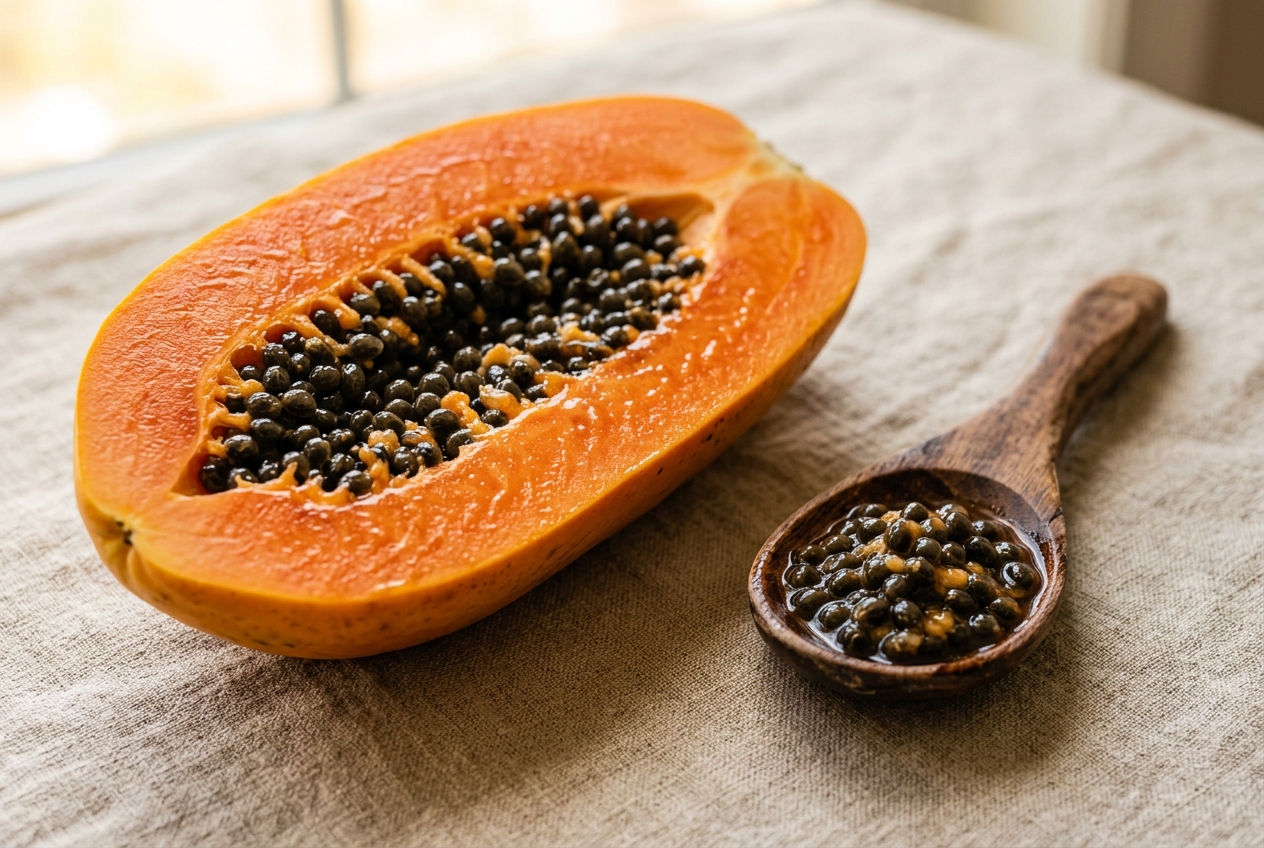
Whenever a fresh tropical papaya (Carica papaya L.) is sliced in half, most people scoop out the glistening, gelatinous black seeds and immediately discard them into the compost.
In recent years, however, a viral wellness trend has urged consumers to eat raw papaya seeds by the spoonful as a natural “miracle parasite cleanse.” Proponents claim that chewing the seeds will instantly expel intestinal worms, eradicate pathogenic gut bacteria, and detoxify the liver.
Is this legitimate botanical pharmacology or dangerous internet pseudoscience?
The answer lies in rigorous clinical biochemistry. Papaya seeds do contain potent anthelmintic (anti-parasitic) compounds—specifically Benzyl Isothiocyanate and the piperidine alkaloid Carpaine—with legitimate human clinical trials demonstrating a 76.7% parasite clearance rate.
However, they are also concentrated with bioactive alkaloids that carry real toxicological risks, reproductive contraindications, and mucosal thresholds that must never be ignored.
Above-the-Fold Anthelmintic & Botanical Comparison Matrix
To separate evidence-based clinical medicine from social media exaggeration, evaluate papaya seeds against other common gut-cleansing protocols:
| Protocol / Agent | Primary Active Compounds | Clinical Parasite Clearance Rate | Gut Biofilm Disruption | Safety & Toxicity Profile | Pregnancy Safety Status |
|---|---|---|---|---|---|
| Dried Papaya Seeds + Honey Clinical Trial Proven | Benzyl Isothiocyanate (BITC) + Carpaine | 76.7% Clearance (Okeniyi et al. RCT) | High (Proteolytic Papain action) | Safe at 1 tsp/day (Avoid overdose) | Strictly Contraindicated |
| Raw Pumpkin Seeds (Pepitas) | Cucurbitin (Amino acid) + Delta-7-Sterols | ~60% to 70% (Paralyzes tapeworms) | Moderate | Extremely Safe (Zero toxic alkaloids) | 100% Safe (Nutritive food) |
| Prescription Albendazole / Mebendazole | Benzimidazole (Microtubule inhibitor) | 90% to 98% (Broad-spectrum drug) | Low (Chemical vermicide only) | Hepatic monitoring required | Strictly Contraindicated |
| Raw Garlic (Allicin Protocol) | Diallyl Thiosulfinate (Allicin) | ~50% (Antimicrobial / Amoebicidal) | Very High | High safety (Mild gastric reflux) | Safe in standard culinary amounts |
1. The 2007 Okeniyi Clinical Trial: The Evidence for Parasite Clearance
The primary human trial substantiating the anti-parasitic efficacy of Carica papaya seeds was conducted by Dr. J.A.O. Okeniyi and colleagues and published in the Journal of Medicinal Food:
- The Cohort: 60 asymptomatic Nigerian school children with stool-confirmed microscopic evidence of intestinal parasites (including Ascaris lumbricoides, Trichuris trichiura, and Giardia lamblia).
- The Intervention: Children were randomized to receive either 20 ml of an air-dried Carica papaya seed concoction blended with raw honey or an identical dose of pure honey alone (placebo) once daily for 7 continuous days.
- The Stool Retest: Repeat microscopic stool evaluations performed on day 7 revealed that 76.7% (23 out of 30) of the children in the papaya seed group achieved complete parasite clearance, compared to only 16.7% in the honey control group (p < 0.001).
- Adverse Events: Zero significant clinical adverse events, vomiting, or diarrhea were documented at the therapeutic dose.
[ 7-DAY RANDOMIZED CONTROLLED CLINICAL TRIAL (Okeniyi et al.) ]

Stool-Confirmed Intestinal Parasite Clearance:
Dried Papaya Seeds + Honey:  ████████████████ 76.7% Clearance (p < 0.001)
Honey Alone (Control):        ███ 16.7% Clearance
2. Molecular Mechanisms: BITC, Carpaine, and Papain
How do tiny papaya seeds achieve such aggressive anthelmintic effects? The answer lies in a triumvirate of biochemical compounds:
[ Crushed Papaya Seed Matrix ]
               │
   ┌───────────┼───────────┐
   ▼           ▼           ▼
[ BITC ]  [ Carpaine ]  [ Papain ]
   │           │           │
   ▼           ▼           ▼
Paralyzes  Disrupts    Dissolves
Nematode   Parasite    Outer Worm
Muscles   Membranes    Cuticle
1. Benzyl Isothiocyanate (BITC)
Like broccoli sprouts, papaya seeds contain a glucosinolate precursor—glucotropaeolin—which, upon cellular mastication, is cleaved by endogenous myrosinase to yield Benzyl Isothiocyanate (BITC). * BITC is a lipophilic organosulfur molecule that readily penetrates the cuticle of helminth parasites. * It uncouples oxidative phosphorylation in parasitic mitochondria and disrupts tubulin polymerization, causing flaccid muscular paralysis in parasitic roundworms so they lose their grip on the intestinal mucosa and are expelled in the stool.
2. Carpaine: The Piperidine Alkaloid
Papaya seeds contain significant quantities of carpaine, a major macrocyclic dilactone piperidine alkaloid (C₂₈H₅₀N₂O₄). Carpaine exhibits potent amoebicidal and vermifuge activity. However, in high doses, carpaine exerts direct cardiodepressant effects (slowing heart rate and lowering arterial blood pressure), which is why dosage must remain strictly controlled.
3. Papain: The Biofilm & Cuticle Dissolver
Papaya seeds contain trace amounts of the proteolytic enzyme papain, a cysteine endopeptidase. While adult parasitic worms protect themselves with a thick mucoprotein coating, papain hydrolyzes these peptide bonds, digesting the outer protective cuticle of the worm and stripping pathogenic gut biofilms.
3. The Dark Side: Toxicology, Fertility, and Pregnancy Warnings
While internet influencers casually promote eating multiple tablespoons of papaya seeds daily, medical toxicology reveals significant cautions:
🌱 Editor's Recommended Botanical Gut Formulations
Laboratory Screened for Purity- 100% pure Carica papaya seeds, gently air-dried below 110°F
- Whole and unground to preserve volatile benzyl isothiocyanate
- Third-party tested for heavy metals, pesticides, and mold
- Ideal for home grinding in a pepper mill over savory dishes
- Rich in natural cucurbitin, a safe anthelmintic amino acid
- Sprouted to neutralize 40%+ of phytic acid; zero toxic alkaloids
- 100% pregnancy-safe alternative for gentle intestinal cleansing
- Delivers 8.5g complete plant protein and 2.2mg bioavailable zinc
1. Pregnancy Contraindication: Teratogenic & Abortifacient Risks
In traditional folklore across Southeast Asia and India, high-dose papaya seeds were used as an abortifacient and emmenagogue. Controlled animal toxicology studies confirm that high concentrations of benzyl isothiocyanate and carpaine stimulate uterine smooth muscle contractions, impair progesterone signaling, and interfere with blastocyst implantation.
Absolute Medical Rule: Pregnant women, nursing mothers, or individuals actively trying to conceive must never consume papaya seeds or high-dose papaya extracts.
2. Temporary Male Anti-Fertility Effects
Extensive veterinary and rodent studies demonstrate that daily high-dose consumption of papaya seed extract induces reversible azoospermia (suppression of sperm production) and blunts sperm motility without altering testosterone levels. Spermatogenesis returns to normal roughly 60 days after cessation.
3. Gastric Mucosal Irritation
Because benzyl isothiocyanate is chemically similar to the allyl isothiocyanates found in horseradish and wasabi, consuming more than 1 tablespoon of raw crushed seeds at once can cause acute chemical irritation of the stomach lining, gastritis, and burning heartburn.
4. Can You Eat Papaya Seeds Daily? How to Eat Papaya Seeds Safely in a 7-Day Protocol
Many consumers ask: can you eat papaya seeds every single day? While raw seeds contain valuable proteolytic carpaine and anthelmintic benzyl isothiocyanate (BITC), chronic high-dose consumption is not advisable due to potential antifertility and mucosal irritation effects. However, a structured 7-day protocol is well-tolerated.
How to Eat Papaya Seeds Safely: Culinary Integration
- Fresh Whole Seed Method: Scoop 1/2 to 1 teaspoon of fresh papaya seeds directly from a ripe fruit and swallow whole with a large glass of water.
- Peppercorn Pepper Grinder Hack: Dehydrate seeds at room temperature for 48 hours, place in a spice grinder, and crack over salads or bone broth for a spicy, cress-like kick.
- Acidity Masking in Smoothies: Blend 1 teaspoon into citrus or pineapple smoothies to neutralize natural alkaloid bitterness.
To explore how gut microbiome diversity benefits from diverse seed species, read our 30-plants per week gut protocol, log your score in our 30-Plants Microbiome Diversity Tracker, review gentle gel fibers in our chia seeds hydration guide, learn the mechanics of seed coatings in our guide on why whole flaxseeds pass through you, and calculate complete seed nutrient yields with our Daily Seed Nutrition Stacker.
5. The Safe 7-Day Clinical Cleansing Protocol
If you and your healthcare practitioner choose to utilize papaya seeds for gut microbiome balancing or travel-related digestive support, follow this precise, safety-tested protocol:
[ THE CLINICAL 7-DAY PAPAYA SEED PROTOCOL ]

Daily Dosage:
• 1 teaspoon (approx. 4g) fresh papaya seeds OR 1/2 teaspoon dried ground powder

Preparation Method:
• Scoop 1 level teaspoon of fresh seeds directly from a ripe organic papaya.
• Mix with 1 tablespoon of raw unpasteurized honey (the honey masks the intense
  peppery bite and provides osmotic synergy against helminth cuticles).
• Chew the seeds thoroughly to fracture the shells and liberate myrosinase.

Timing & Duration:
• Take once daily first thing in the morning on an empty stomach with a large glass of water.
• Continue for exactly 7 to 10 consecutive days.
• Discontinue completely after day 10. Do NOT use as a continuous daily dietary staple.
6. Integrating Gentle Seeds for Ongoing Gut Health
While papaya seeds are an acute, short-term botanical intervention, long-term gut microbiome resilience is best cultivated through daily intake of gentle, prebiotic seeds rich in soluble mucilage fiber—such as chia seeds, sweet basil seeds (sabja), and ground flaxseed.
To calculate your daily soluble fiber targets and balance your seed intake, use our interactive Daily Seed Nutrition & Protein Stacker, or log your weekly intake of 30 distinct plant species on our 30-Plants Microbiome Tracker.
Frequently Asked Questions: Papaya Seeds & Gut Health
Yes, there is credible clinical evidence. In a landmark randomized controlled trial published in the Journal of Medicinal Food by Okeniyi et al., a dried Carica papaya seed concoction cleared stool-confirmed intestinal parasites in 76.7% of treated subjects within 7 days, compared to only 16.7% in the placebo group, with zero significant adverse events.
Fresh raw papaya seeds have a sharp, pungent, peppery flavor profile remarkably similar to black peppercorns, horseradish, or wasabi, caused by the enzyme-catalyzed release of benzyl isothiocyanate (BITC). The easiest way to consume them is by blending 1 teaspoon of fresh seeds into a fruit smoothie, or drying them and using them in a pepper grinder over savory salads.
The clinically safe therapeutic dose is 1 teaspoon (approximately 4 to 5 grams) of fresh or dried ground papaya seeds per day, consumed with a meal or mixed into raw honey for 7 to 10 consecutive days. Never exceed 1 tablespoon per day, as excessive intake can irritate the gastric mucosa and cause nausea from high alkaloid concentrations.
No. Papaya seeds are strictly contraindicated during pregnancy and breastfeeding. Animal toxicology studies demonstrate that concentrated papaya seed extracts and their active alkaloids (carpaine and benzyl isothiocyanate) can trigger uterine contractions, impair embryonic implantation, and cause teratogenic risks. Individuals actively attempting to conceive should also avoid them.