
Never Eat Chia Seeds Dry: The Hydration & Intestinal Blockage Rule Most People Miss
A medical and biochemical breakdown of the 12x mucilage expansion index, why swallowing dry chia seeds poses a documented esophageal blockage risk, and the clinical soaking protocols for maximum nutrient absorption.
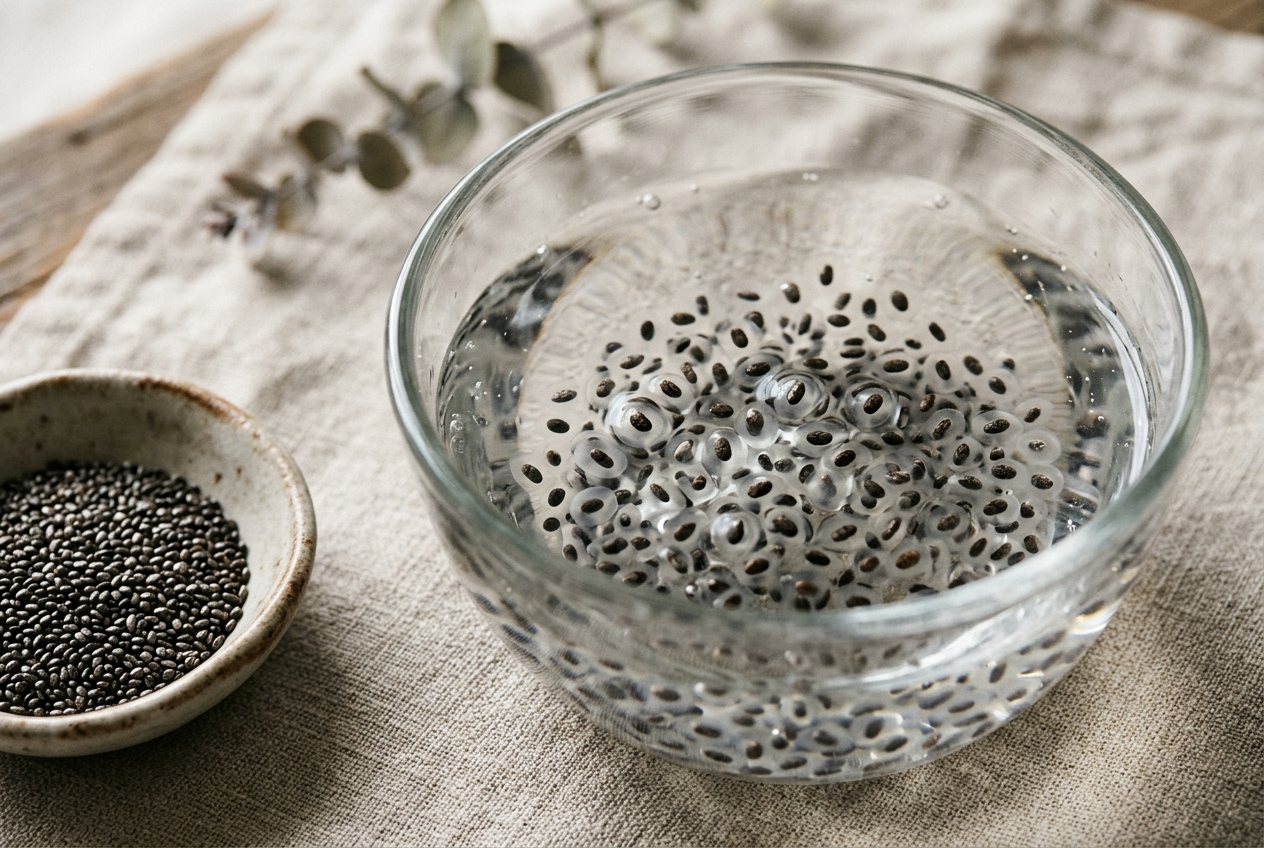
Chia seeds (Salvia hispanica L.) have achieved universal acclaim as a modern superfood, celebrated for their extraordinary concentrations of Alpha-Linolenic Acid (ALA Omega-3), soluble dietary fiber, and plant-based calcium. Wellness influencers routinely advise followers to sprinkle raw chia onto everything from salads and granolas to post-workout protein shakes.
However, clinical gastroenterologists and botanical biochemists share a crucial warning that rarely reaches social media: consuming dry, unhydrated chia seeds is a documented medical hazard capable of causing acute esophageal obstruction and severe intestinal impaction.
Chia is not a passive grain. The outer epidermal cells of the chia seed coat are biologically engineered with a massive, hygroscopic polysaccharide reservoir that expands violently when exposed to liquid. When that liquid comes from your esophagus rather than a prep bowl, the outcome can require emergency endoscopic surgery.
How long to soak chia seeds: Chia seeds should be soaked for a minimum of 15 to 20 minutes at room temperature for rapid gel formation, or 2 to 8 hours (overnight in the refrigerator) for complete hydrophilic polysaccharide expansion. The clinical golden ratio is 1 part chia seeds to 6 parts liquid (2 tablespoons seeds to 3/4 cup liquid), ensuring zero risk of gastrointestinal dehydration.
Above-the-Fold Hydration & Bioavailability Comparison Matrix
Review the critical differences in fluid dynamics, enzymatic bioaccessibility, and gastrointestinal transit across four preparation states:
| Chia Seed State | Water Absorption | Esophageal Hazard | Soluble Fiber Bioavailability | Glycemic Blunting Speed | Gut Microbiome Transit |
|---|---|---|---|---|---|
| Dry Unsoaked (Raw Spoonful) | Zero (Pre-Ingestion) | Critical Danger (Phytobezoar) | Very Low (< 20% accessible) | Negligible (Delayed transit) | Sluggish / High Impaction Risk |
| Rapid Hydrated (15 Minutes) | 7x - 8x dry weight | Zero (Safe fluid gel) | High (~75% bioaccessible) | Moderate (Curbs insulin spikes) | Smooth peristaltic clearance |
| Overnight Cold-Soaked Gel (8-12h) Clinical Gold Standard | 12x dry weight (Max) | Zero (Fully saturated matrix) | Maximum (100% liberated) | Highest (Stabilizes glucose curve) | Rapid SCFA butyrate fermentation |
| Cold-Milled Chia Seed Flour | 10x dry weight (Rapid) | Low (Slurry formation) | Very High (Cell walls fractured) | High (Immediate lipid access) | High lipid absorption / Low bulk |
1. The 12x Mucilage Expansion Index: The Clinical Physics
The seed coat of Salvia hispanica contains specialized epidermal cells that synthesize a complex hydrophilic polysaccharide upon seed maturation. This mucilage is composed of a branched heteropolysaccharide containing: * D-xylose (~38%) * D-glucose (~35%) * 4-O-methyl-α-D-glucuronic acid (~12%) * Trace galactose and arabinose residues
When dry chia seeds encounter water, the dry polysaccharide chains undergo spontaneous hydration. Water molecules enter the matrix via osmotic pressure and capillary action, forming hydrogen bonds with the hydroxyl groups of the sugar residues.
Dry Chia Seed (1g) + 12g H₂O → Viscous Hydrogel (13g)
This physical expansion exerts a volumetric swelling factor of 1,000% to 1,200%.
The Medical Precedent: The 2014 ACG Esophageal Case
In a landmark clinical presentation published at the American College of Gastroenterology (ACG) Annual Scientific Meeting, a 39-year-old male with a history of mild asthma and dysphagia swallowed one tablespoon of dry raw chia seeds, immediately chased by a tall glass of cold water.
Within 45 seconds, the dry seeds adhered to the mucosal lining of his middle esophagus, rapidly drawing in the swallowed water and surrounding esophageal secretions. The seeds fused into a solid, hydrogel phytobezoar that completely occluded his esophageal lumen.
Because the mucilage gel is an adhesive non-Newtonian fluid, conventional suction, saline flushing, and endoscopic pushing catheters failed. Gastroenterologists had to insert an endoscopic mucosal resection snare to mechanically morcellate the gel mass piece by piece over several hours.
2. Why Dry Chia Robs Your Digestive System of Water
Even if dry chia seeds bypass the esophagus without causing acute obstruction, consuming unhydrated seeds causes secondary dehydration in the lower gastrointestinal tract.
[ Dry Chia Ingested ] ──► Pulls Water From Duodenum/Colon ──► Systemic Water Depletion
                                     │
                                     ▼
                   Dense Colonic Stool Hardening (Constipation)
As the dry seeds travel through the stomach and duodenum, they aggressively extract fluid from the surrounding mucosal tissues and vascular bed. If systemic hydration is insufficient, the expanding seeds dry out the colonic contents, turning what should have been a bowel-regulating superfood into hard, dry stool that precipitates acute constipation and cramping.
Conversely, when pre-hydrated, chia seeds deliver up to 360ml of structured botanical water directly to the colon, hydrating stool, easing peristalsis, and feeding butyrate-producing commensal bacteria.
3. Do Chia Seeds Go Bad? The Lipid Oxidation Reality
A frequent search query from health-conscious consumers is: do chia seeds go bad?
Unlike flaxseeds, which oxidize rapidly within 15 minutes of mechanical grinding, whole chia seeds possess an extraordinary natural defense mechanism. Chia contains dense concentrations of natural phenolic antioxidants: * Chlorogenic Acid: Scavenges peroxyl free radicals * Caffeic Acid: Inhibits lipid peroxidation in cell membranes * Quercetin & Kaempferol: Flavonols that chelate transition metals
These endogenous antioxidants shield chia’s fragile Alpha-Linolenic Acid (ALA Omega-3) fatty acid chains (C₁₈H₃₀O₂, featuring three vulnerable double bonds) from atmospheric auto-oxidation.
🌱 Editor's Recommended Organic Chia Seeds
Triple-Cleaned Purity- 100% Certified USDA Organic & Non-GMO Project Verified
- Cold-grown in high-altitude volcanic soils for peak ALA density
- Triple-cleaned: zero debris, micro-stones, or wild weed seeds
- Delivers 5,000mg Alpha-Linolenic Acid per 30g serving
- Third-party tested for lead, cadmium, and microbial safety
- Uniform seed size optimizing fast 15-minute gel formation
- Neutral flavor profile: ideal for savory dressings and puddings
- Over 10g of total dietary fiber per 2-tablespoon dose
The 4 Signs Your Chia Seeds Have Expired:
- The Bitter Paint Odor: Fresh chia smells mildly earthy and neutral. Oxidized chia smells distinctly of linseed oil, turpentine, or bitter paint varnish due to volatile hexanal formation.
- Moisture Clumping: If seeds form clumps in the bag, environmental moisture has penetrated, potentially incubating microscopic mycotoxins.
- Loss of Gel Kinetics: If a spoonful of seeds placed in water fails to develop a thick halo of clear mucilage within 20 minutes, the cell membrane integrity has degraded.
- Acrid Taste: Fresh chia has a silky, neutral flavor. Rancid chia has an astringent, sour, throat-scratching aftertaste.
Shelf-Life Rule: Keep whole dry chia seeds in an opaque, airtight glass container at room temperature for up to 3 years. Once soaked into a gel, store in the refrigerator and consume within 5 to 7 days.
4. How Long to Soak Chia Seeds: The 3 Clinical Hydration Protocols
To ensure 100% safety and unlock the prebiotic benefits of chia mucilage, use one of these three standardized preparation protocols:
Protocol A: The 15-Minute Functional Hydration Beverage
- Ratio: 1 tablespoon (12g) chia seeds to 8–10 oz (250ml) liquid (filtered water, coconut water, or green tea).
- Method: Add seeds to the liquid. Stir vigorously with a fork or mini whisk for 60 seconds to prevent seeds from clumping at the bottom. Rest for 5 minutes, then stir once more.
- Result: A free-flowing botanical beverage with suspended, fully enveloped seeds that will never adhere to the esophagus.
Protocol B: The Overnight Prebiotic Pudding Base
- Ratio: 3 tablespoons (36g) chia seeds to 1 cup (240ml) unsweetened almond, hemp, or oat milk.
- Method: Whisk thoroughly, cover, and place in the refrigerator for 8 to 12 hours.
- Result: A rich, spoonable gel that slows gastric emptying, blunts glucose absorption from accompanying carbohydrates, and provides a continuous substrate for colonic microbiome fermentation.
Protocol C: The High-Speed Blender Hack
If you prefer not to wait for seeds to soak, add dry chia seeds directly into a high-speed blender container alongside at least 12 ounces of liquid (smoothie base). The high-shear stainless-steel blades fracture the hard seed coats in seconds, instantly emulsifying the fats and mucilage into the liquid without creating large adhesive gel clumps.
Shelf Life & Storage: Do Chia Seeds Go Bad?
A frequent question among botanical consumers is: do chia seeds go bad if left at room temperature? Because Salvia hispanica contains exceptionally high concentrations of natural polyphenols (chlorogenic acid, caffeic acid, quercetin, and kaempferol), dry unsoaked chia seeds remain shelf-stable for up to 4 years in an airtight container away from direct sunlight. However, once hydrated into chia gel, ambient airborne microbes and hydrolytic activity limit cold gel stability to 5 to 7 days in the refrigerator.
Cross-Botanical Mucilage & Nutrient Synergy
If you need a rapid-mucilage alternative that hydrates in under 5 minutes without clumping, explore our comparative showdown on basil seeds vs chia seeds. For a broader macronutrient breakdown against hemp hearts and flax, review our flagship hemp vs chia vs flax seed nutrient density comparison. And to discover why unground seed coats resist gastric acid, see our bioaccessibility guide on why whole flaxseeds pass right through you.
5. Integrating Chia Into Your Daily Botanical Routine
Chia seeds are an exceptional tool for metabolic longevity, but only when prepared with scientific respect for their physical chemistry.
By combining 1 tablespoon of pre-hydrated chia seeds with freshly ground flaxseeds and shelled hemp hearts, you achieve the clinically revered Tri-Seed Protocol—delivering balanced Omega-3 fats, complete plant protein, and both soluble and insoluble fiber fractions.
To model your exact daily micronutrient yields and adjust seed ratios for your specific health goals, use our free Daily Seed Nutrition & Protein Stacker, or track your weekly species diversity using the 30-Plants Microbiome Tracker.
Frequently Asked Questions About Chia Seed Hydration & Safety
While you can technically consume dry chia seeds in micro-quantities (such as sprinkled over already-hydrated yogurt or blended into high-liquid smoothies), swallowing dry whole chia seeds by the spoonful is dangerous. Upon contact with esophageal fluid, they instantly absorb moisture and swell up to 12 times their dry weight, forming a tenacious gel ball that can lodge in the esophagus or intestines.
Chia seeds begin releasing mucilage within 30 seconds of water contact, but achieving complete polysaccharide saturation requires a minimum of 15 to 20 minutes at room temperature with vigorous stirring. For maximum prebiotic solubility and postprandial glucose blunting, an overnight cold soak of 8 to 12 hours in the refrigerator is the clinical gold standard.
Whole, dry chia seeds have an extraordinarily long shelf life of 2 to 4 years when stored in an airtight container away from heat and sunlight. This stability is due to exceptionally high concentrations of natural antioxidant polyphenols (chlorogenic acid, caffeic acid, quercetin). If chia seeds develop a bitter chemical odor, clump together from humidity, or taste harsh and sour, the polyunsaturated omega-3 fatty acids have oxidized and the batch should be discarded.
Laboratory testing demonstrates that whole chia seeds exhibit a water-holding capacity (WHC) of 10 to 12 times their dry weight. A 30-gram (2-tablespoon) serving of dry chia seeds will absorb approximately 300 to 360 milliliters (over 1.5 cups) of liquid, transforming into a dense, gelatinous prebiotic mass.